
Under-Sink RO System Questions to Ask Before Buying 💧🛠️📸

Buying an under-sink reverse osmosis system sounds simple until the options start blending together. One unit has five filtration stages. Another claims higher flow. One includes a remineralization filter, while another costs half as much but needs more frequent replacement cartridges.
The right choice starts with the right questions.
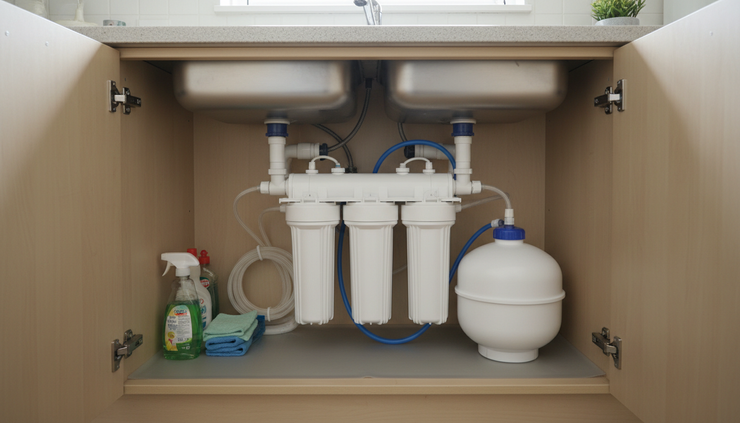
An under-sink RO system can be a smart way to improve drinking water at home, but it should match your water, your household, your sink cabinet, and your budget. Before buying, use the questions below to compare systems with confidence and avoid paying for features you do not need. 💧
What is actually in your water? 🧪
Before comparing filters, start with the water itself. Reverse osmosis is useful for reducing many dissolved contaminants, but not every home has the same water problem.
Ask these questions first:
Do I use city water or well water?
City water is usually treated and tested by the local utility. Well water is the homeowner’s responsibility and may need more complete testing.
Does my water have chlorine or chloramine?
Many municipal systems use disinfectants. Carbon pre-filters help protect the RO membrane from chlorine, but chloramine may require a different carbon filter or longer contact time.
Is my water hard?
Hard water contains minerals like calcium and magnesium. Very hard water can shorten membrane life and cause scale buildup. In some homes, a softener before the RO system may help.
Do I have concerns about lead, arsenic, nitrates, fluoride, PFAS, or TDS?
RO systems can reduce many contaminants, but performance varies by model. Look for certified reduction claims, not just broad marketing language.
Does the water smell, taste metallic, or leave stains?
Taste and odor can point to chlorine, sulfur, iron, or other issues. These clues do not replace testing, but they help guide what to test for.
Should you test your water before buying?
Yes, if possible. A basic water test can prevent overbuying or underbuying.
For city water, check your local annual water quality report, often called a Consumer Confidence Report in the United States. It gives a useful baseline. For older homes, especially those with possible lead plumbing, an at-home or lab test can add peace of mind.
For well water, testing matters even more. At minimum, many homeowners test for bacteria, nitrates, pH, hardness, iron, manganese, and total dissolved solids. Depending on the region, it may also make sense to test for arsenic or other local concerns.
A filter should be chosen for the water you have, not the water you assume you have.
What contaminants is the system certified to reduce? ✅
RO systems often use impressive claims, but the most useful question is simple: What has this system been tested to reduce?
Look for independent certifications when available. NSF/ANSI Standard 58 is commonly associated with reverse osmosis systems. Some systems may also list certifications for components such as carbon filters or faucets.
Ask:
Which contaminants does the system reduce?
Are the reduction claims backed by third-party testing?
Does the certification apply to the whole system or only one part?
Are test results easy to find in the manual or product listing?
Does the system reduce the specific contaminants in my water test?
Be careful with vague phrases like “removes all impurities.” No home water filter removes everything under every condition. A trustworthy brand should explain what the unit targets and what it does not.
How much water can the system produce each day? 🚰
Capacity affects daily convenience. RO systems are often rated by how many gallons per day they can produce under ideal conditions. Real-world output can be lower because water temperature, pressure, and TDS levels affect performance.
Ask these questions:
How many people will use the RO water each day?
A single-person household has different needs than a family that fills water bottles, cooks with filtered water, and gives filtered water to pets.
Will I use RO water only for drinking, or also for cooking?
Cooking pasta, making coffee, filling a humidifier, and rinsing produce all increase demand.
Does the system have a storage tank?
Many traditional under-sink systems store filtered water in a tank. Tankless systems filter on demand and may save cabinet space, but they need a strong enough flow rate to feel convenient.
How fast does the faucet dispense water?
A high daily production rating does not always mean fast faucet flow. Check user reviews for complaints about slow filling.
What water pressure does the system require?
Low home water pressure can reduce output. Some systems include or support a booster pump.
A helpful rule is to think beyond drinking glasses. If filtered water will become your main kitchen water source, choose a system that can keep up during busy times, such as mornings and dinner prep.

How many filtration stages do you really need? 🧩
A common selling point is the number of filtration stages. More stages can be useful, but more is not always better. What matters is what each stage actually does.
Most under-sink RO systems include some combination of these:
Filtration stage | What it usually does | Question to ask |
Sediment filter | Catches sand, rust, and particles | Is my water prone to visible sediment? |
Carbon pre-filter | Reduces chlorine, taste, and odor | Does it protect the RO membrane from disinfectants? |
RO membrane | Reduces many dissolved solids | What contaminants is it certified to reduce? |
Carbon post-filter | Polishes taste before water reaches the faucet | How often does it need replacement? |
Remineralization filter | Adds some minerals back for taste | Do I prefer a more mineral-like flavor? |
UV light | Targets certain microorganisms | Do I have well water or bacteria concerns? |
Do you need remineralization?
RO water can taste flat to some people because the process reduces dissolved minerals. A remineralization stage can improve taste and slightly raise pH. It is not essential for everyone, but it can make the water more pleasant.
Ask:
Does the system include remineralization?
Can I add it later?
Does it change the taste in a way I like?
How much does the replacement cartridge cost?
Do you need UV protection?
UV is not a standard need for every home. It is more common for well water or homes with possible microbial concerns. If bacteria are found in a water test, an RO system alone may not be the full answer. In that case, speak with a qualified water treatment professional.
Will it fit under your sink? 📏
Under-sink space looks bigger until you account for drain pipes, garbage disposals, pull-out sprayer hoses, cleaning supplies, and the RO storage tank.
Before buying, measure:
Cabinet width, height, and depth
Available space around the drain pipe
Distance to the cold water line
Space for the storage tank, if included
Room to remove filters during maintenance
Space for an electrical outlet, if the unit has a pump or UV light
Tank systems usually need more room. Tankless systems can be more compact, but they may require power and can cost more upfront.
Also check the faucet situation. Many RO systems include a dedicated faucet. That means you need an available sink hole. If your sink has no extra hole, you may need to drill one into the countertop, which can be simple or risky depending on the material. Stone, quartz, and some solid surfaces need extra care.

What will installation require? 🛠️
Some homeowners install an under-sink RO system themselves. Others prefer a plumber. The right choice depends on comfort level, cabinet layout, tools, and local plumbing conditions.
Ask before you buy:
Does the system include all fittings, tubing, faucet parts, and drain saddle hardware?
Are the instructions clear and specific?
Does the system connect to a standard cold water line?
Will I need to drill a faucet hole?
Does the system require electricity?
Does installation affect the garbage disposal or dishwasher line?
Can the filters be mounted securely inside the cabinet?
A good manual should include diagrams, not just text. It should also explain how to flush the system before drinking the water. New filters and membranes often need flushing to remove loose carbon fines or preserve solution from the membrane.
If you rent, ask the property owner before installing anything that modifies plumbing or countertops.
How much maintenance will it need? 🔄
A reverse osmosis system is not a set-it-and-forget-it appliance. It works best when filters are replaced on schedule.
Ask:
How often do the sediment and carbon filters need replacement?
How long does the RO membrane usually last?
Does the system have a filter change indicator?
Are filters twist-in style or do they require a wrench?
Can replacement filters be purchased easily?
Are replacement filters proprietary?
How much does a full year of maintenance cost?
Proprietary filters are not always bad. They can be easier to install and reduce the chance of using the wrong cartridge. But they may cost more and limit where you can buy replacements.
Also ask about sanitation. Some brands recommend sanitizing the tank and lines at certain intervals. If the instructions are hidden or confusing, maintenance may become a nuisance.
A maintenance-friendly system should make filter access easy. If you have to empty the entire cabinet and wrestle with housings every few months, you are less likely to stay on schedule.
How much water does it waste? ♻️
Reverse osmosis systems send some water to the drain as they flush contaminants away from the membrane. This is normal, but efficiency varies.
Ask:
What is the system’s filtered-water-to-drain-water ratio?
Does it include a permeate pump or booster pump?
Does higher efficiency require electricity?
Will water pressure in my home affect waste?
Am I comfortable with the water use?
Tankless systems and systems with pumps may waste less water than basic older designs, but compare product specifications carefully. If water conservation is a priority, this question deserves a top spot.
What is the true cost over several years? 💵
The sticker price is only one part of the cost. A cheaper unit can become expensive if filters cost a lot or need frequent replacement.
Compare these costs:
Cost item | Why it matters |
Purchase price | The upfront cost of the system |
Installation | DIY may cost less, professional installation may reduce mistakes |
Replacement filters | Recurring cost that affects long-term value |
RO membrane | Less frequent, but usually more expensive than basic filters |
Remineralization cartridges | Optional on some systems, recurring on others |
UV lamp replacement | Relevant only if the system includes UV |
Faucet upgrades | Some buyers replace basic included faucets |
Leak detector or shutoff valve | Helpful extra protection under the sink |
A practical way to compare systems is to estimate the total cost for the first three years. Include the unit, installation, and expected filter changes. This gives a clearer picture than the purchase price alone.
What does the warranty actually cover? 🧾
A warranty can signal confidence, but only if the terms are clear.
Ask:
How long is the warranty?
Does it cover the whole system or only certain parts?
Are filters and membranes excluded?
What voids the warranty?
Is proof of purchase required?
Who pays shipping for warranty parts?
Is customer support easy to reach?
Also check whether the brand offers replacement parts beyond filters. Faucets, tanks, tubing, fittings, and housings can wear or fail. A system is easier to own when parts are available.
Do not judge warranty length alone. A shorter warranty from a responsive company may be more useful than a longer warranty with poor support.
What do real customers say? ⭐
Reviews can reveal problems that product pages do not mention. Read them with a practical eye.
Look for patterns around:
Leaks after installation
Slow flow from the faucet
Poor-tasting water after flushing
Missing parts
Confusing instructions
Filter replacement difficulty
Noisy pumps
Helpful or unhelpful customer service
Trouble finding replacement filters
One negative review is not enough to reject a system. Every product can have defects or installation mistakes. Repeated complaints about the same issue matter more.
Also look for reviews from people with similar needs. A review from a well-water household may not apply to a city-water apartment. A family of five will judge capacity differently than someone living alone.

Does the brand make ownership simple? 📦
A good brand makes the buying decision easier and the next few years smoother.
Ask:
Is the manual available before purchase?
Are replacement filters easy to identify?
Does the brand publish clear maintenance schedules?
Can customer support answer technical questions?
Are installation videos or diagrams available?
Are certified reduction claims clearly listed?
Has the brand been around long enough to support parts?
Brand reputation is not only about popularity. It is about clarity, support, and consistency. If the company hides basic information before the sale, expect ownership to feel harder after the sale.
A quick buying checklist 📝
Before choosing an under-sink RO system, answer these questions:
What does my water test show?
Which contaminants do I want to reduce?
Is the unit certified for those reduction claims?
How much filtered water will my household use daily?
Do I want a tank or tankless design?
How many stages are useful for my water?
Will it fit under my sink with room for maintenance?
Can I install it myself, or should I hire help?
What will filters cost each year?
How efficient is the system with water use?
What does the warranty cover?
Do reviews show repeated problems?
Are replacement parts and filters easy to buy?
If a system checks these boxes, it is much more likely to serve your kitchen well.
The best choice is the one that matches your water 💧
An under-sink RO system can be a great upgrade for drinking water, coffee, cooking, and everyday peace of mind. The key is to buy based on evidence, not just stage count, price, or bold claims.
Start with water testing. Match the system to the contaminants you care about. Check capacity, fit, installation, maintenance, total cost, warranty, and reviews. A few smart questions now can save frustration later and help you choose a system that delivers clean-tasting water day after day.
Serving Palm Beach • Broward • Fort Myers • Naples
Contact us at info@repairedassuredllc.com or call us at 754-333-0826


Comments